

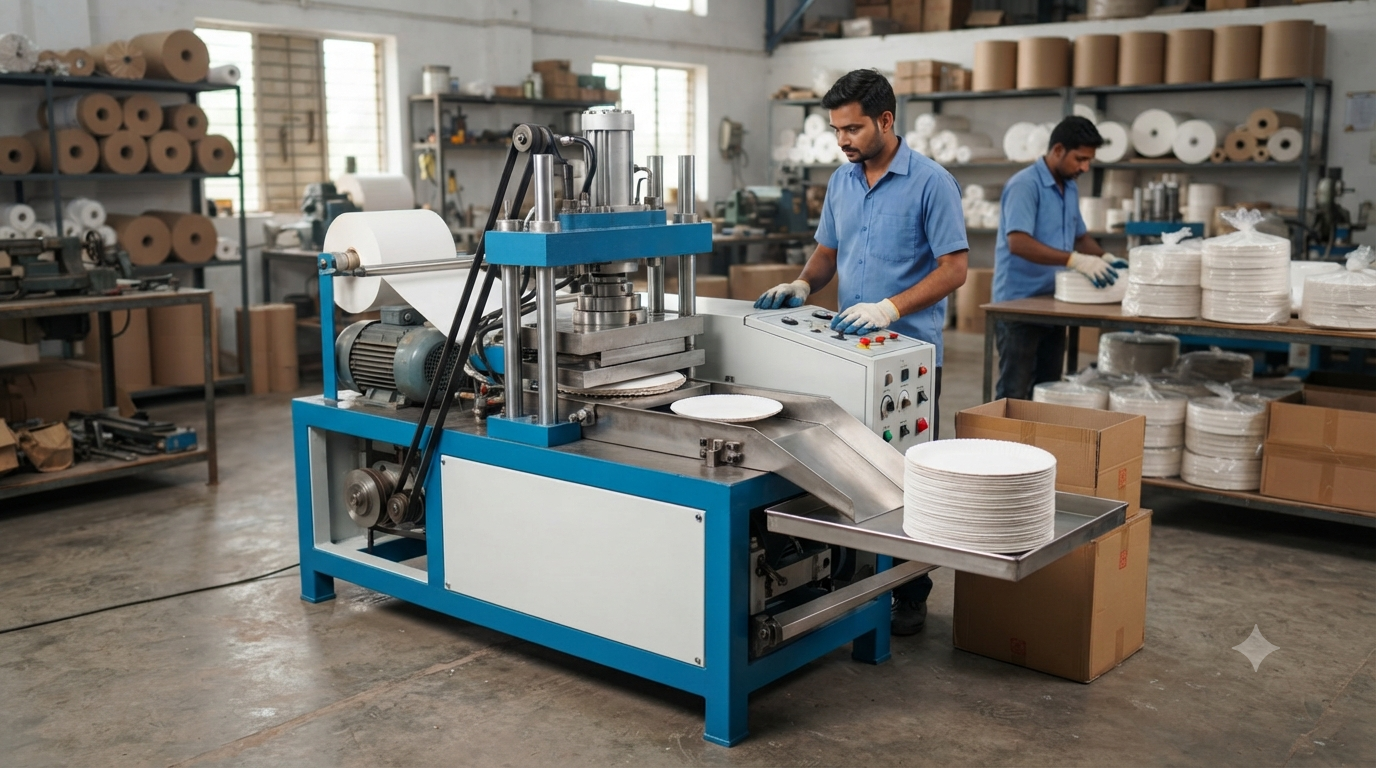
paper-plate-making-machine-business-guide
Learn how a paper plate making machine works, why paper plates are in demand, and how to start a paper plate manufacturing business with the right machine.
e available in different configurations, including single-die machines, double-die machines, and other production models.
The choice of machine depends on factors such as:
- Required production capacity
- Plate sizes and shapes
- Number of dies
- Available workspace
- Budget and business requirements
Why Is a Paper Plate Making Machine Important?
Paper plate making machines play an important role in the disposable products manufacturing industry because they help meet the demand for convenient food-serving products.
1. Convenient Food Serving
Paper plates are commonly used where washing and reusing traditional plates may not be practical.
They are useful for:
- Weddings and functions
- Birthday parties
- Food stalls and street vendors
- Restaurants and takeaway services
- Catering businesses
- Religious and community gatherings
A paper plate manufacturing machine helps businesses produce plates for these different applications.
2. Supports Small and Medium Businesses
Paper plate manufacturing can be explored by entrepreneurs who want to establish a small or medium-scale manufacturing unit.
With the right machine, raw material, workspace, and business planning, a person can begin producing paper plates and gradually develop a customer base.
The business can supply local wholesalers, retailers, caterers, event organisers, and disposable product distributors.
3. Helps Improve Production Efficiency
Manual plate production can be time-consuming and difficult to maintain consistently at higher volumes.
A paper plate making machine helps standardise the forming process and can improve production efficiency compared with manual methods.
The actual output depends on the machine model, plate size, material quality, operator skill, and working conditions.
4. Produces Different Plate Sizes
Different customers require different plate sizes for different purposes.
For example, smaller plates may be used for snacks, while larger plates may be preferred for meals and catering.
With suitable dies, compatible machines can produce plates in multiple sizes and designs.
This gives manufacturers the flexibility to serve a wider range of customers.
5. Creates Manufacturing and Distribution Opportunities
Paper plate manufacturing creates opportunities not only for machine operators but also for businesses involved in raw material supply, packaging, transportation, wholesale distribution, and retail sales.
A well-planned manufacturing business can build relationships with regular buyers and expand its product range over time.
How Does a Paper Plate Making Machine Work?
The working process of a paper plate making machine is simple to understand.
Although the exact process may vary depending on the machine model, the basic manufacturing steps are generally similar.
Step 1: Raw Material Selection
The first step is selecting suitable paper-based raw material.
The material must be compatible with the machine and the required plate design. Its thickness, quality, coating, and size can affect the finished product.
Step 2: Material Feeding
The prepared paper material is placed into the machine’s feeding area.
Depending on the machine type, feeding may be manual or supported by a feeding mechanism.
The operator ensures that the material is correctly positioned before the forming process begins.
Step 3: Die or Mould Formation
The paper is placed between the forming dies.
The die gives the paper its required shape, including the plate’s centre and raised edges.
Different dies can be used to manufacture different plate sizes and designs, provided they are compatible with the machine.
Step 4: Pressing and Shaping
The machine applies pressure to the paper through its forming system.
This pressure shapes the paper into a plate and helps maintain the required structure.
In hydraulic machines, hydraulic pressure is used to operate the forming mechanism. In mechanical machines, the forming action is produced through a mechanical system.
Step 5: Plate Collection
After the forming cycle is completed, the finished plate is removed or collected.
The operator checks the plate for proper shape, edge formation, and overall quality.
Step 6: Inspection and Packaging
The finished plates are inspected and arranged into bundles.
They are then packed according to the manufacturer’s or customer’s requirements and prepared for storage or delivery.
Why Does a Paper Plate Making Machine Work?
The working principle of a paper plate making machine is based on the ability of suitable paper material to be shaped under controlled pressure.
When the paper is placed between the forming dies, the machine applies force to mould it into the required plate shape.
The die determines the size and design, while the machine’s forming system provides the pressure needed for shaping.
The quality of the finished plate depends on several factors:
- Quality and thickness of the paper material
- Correct die selection
- Proper machine pressure and settings
- Suitable temperature, where applicable
- Correct material positioning
- Operator experience and maintenance
When these factors are properly managed, the machine can produce plates with consistent shapes and quality.
How to Start a Paper Plate Manufacturing Business
Starting a paper plate business requires more than purchasing a machine. Entrepreneurs should understand the complete manufacturing and selling process before investing.
1. Understand the Market
Before starting production, research the demand for paper plates in your area.
Identify potential customers such as:
- Disposable product wholesalers
- Local retailers
- Catering companies
- Restaurants and food vendors
- Event organisers
Understanding customer requirements can help you decide which plate sizes and designs to manufacture.
2. Select the Right Machine
Choose a paper plate making machine according to your production requirements and budget.
Consider the machine’s working system, compatible dies, production capacity, maintenance requirements, and available training or service support.
A machine suitable for one business may not be the best choice for another.
3. Arrange Raw Material
Raw material is one of the most important parts of paper plate manufacturing.
Before purchasing a machine, understand the types of paper material required, its availability, quality, and cost.
Reliable raw material sourcing helps maintain consistent production and product quality.
4. Prepare Your Workspace
Arrange a suitable workspace with sufficient room for the machine, raw material storage, finished product storage, and packaging.
Ensure that the electrical supply, ventilation, and safety arrangements meet the machine’s requirements.
5. Learn the Machine’s Working Process
Proper training is important for operating the machine safely and efficiently.
Learn how to feed material, use dies, operate the machine, inspect finished plates, and perform basic maintenance.
6. Build Your Customer Network
Start by contacting local wholesalers, retailers, caterers, and disposable product distributors.
Understand their preferred plate sizes, packaging quantities, and purchasing requirements.
Developing regular customers can help create a more stable business.
Is Paper Plate Manufacturing a Good Business Opportunity?
Paper plate manufacturing can be a business opportunity for entrepreneurs who are prepared to manage production, raw material costs, machine operation, and sales.
However, profitability is not guaranteed.
Before starting, calculate:
- Machine investment
- Raw material cost
- Electricity and operating expenses
- Labour requirements
- Packaging expenses
- Transportation costs
- Selling price and market competition
A proper business plan and local market research can help you make a more informed investment decision.
Choose the Right Paper Plate Making Machine with Bhartiya Machine Works
Bhartiya Machine Works (BWM), a brand by Vidayalaya Granth Pvt. Ltd., provides machinery solutions for entrepreneurs interested in disposable product manufacturing.
If you are planning to start a paper plate or paper dona manufacturing business, choosing the right machine and understanding its working process are important steps.
At Bhartiya Machine Works, entrepreneurs can explore suitable machine options and learn more about the manufacturing process before making a purchase decision.
Whether you are new to manufacturing or looking to expand your existing business, understanding the machine, raw material, and market requirements can help you plan your next step with confidence.
Conclusion
A paper plate making machine is an important part of the disposable paper products manufacturing industry.
It helps transform suitable paper material into finished plates through a controlled forming and pressing process. With the right machine, raw material, training, and business planning, entrepreneurs can explore opportunities in paper plate manufacturing.
The key to building a successful business is not just buying a machine. It is understanding how the machine works, producing quality products, managing costs, and developing a reliable customer network.
If you are interested in starting a paper plate manufacturing business, begin by learning about the machine, studying your local market, and choosing equipment that matches your business requirements.
Bhartiya Machine Works – Helping Entrepreneurs Explore Manufacturing Opportunities.
https://www.youtube.com/channel/UClgNmUom4pWUKhmWUOHbQMA