 notebook-stitching-machine-working-business-guide
https://www.youtube.com/channel/UClgNmUom4pWUKhmWUOHbQMA
Notebook Stitching Machine: How It Works, Its Importance & Notebook Manufacturing Business

Notebooks are essential products used by students, teachers, offices, coaching centres, and businesses. From school exercise books to office notebooks, these products are manufactured through a series of processes that help turn paper and covers into finished stationery items.

One of the important machines used in this process is the Notebook Stitching Machine, also known as a notebook pinning machine or wire stitching machine.

This machine helps join notebook pages and covers together using stitching wire, making it an important part of notebook manufacturing.

For entrepreneurs interested in starting or expanding a notebook manufacturing business, understanding the working and importance of a notebook stitching machine is a useful first step.

WHAT IS A NOTEBOOK STITCHING MACHINE?

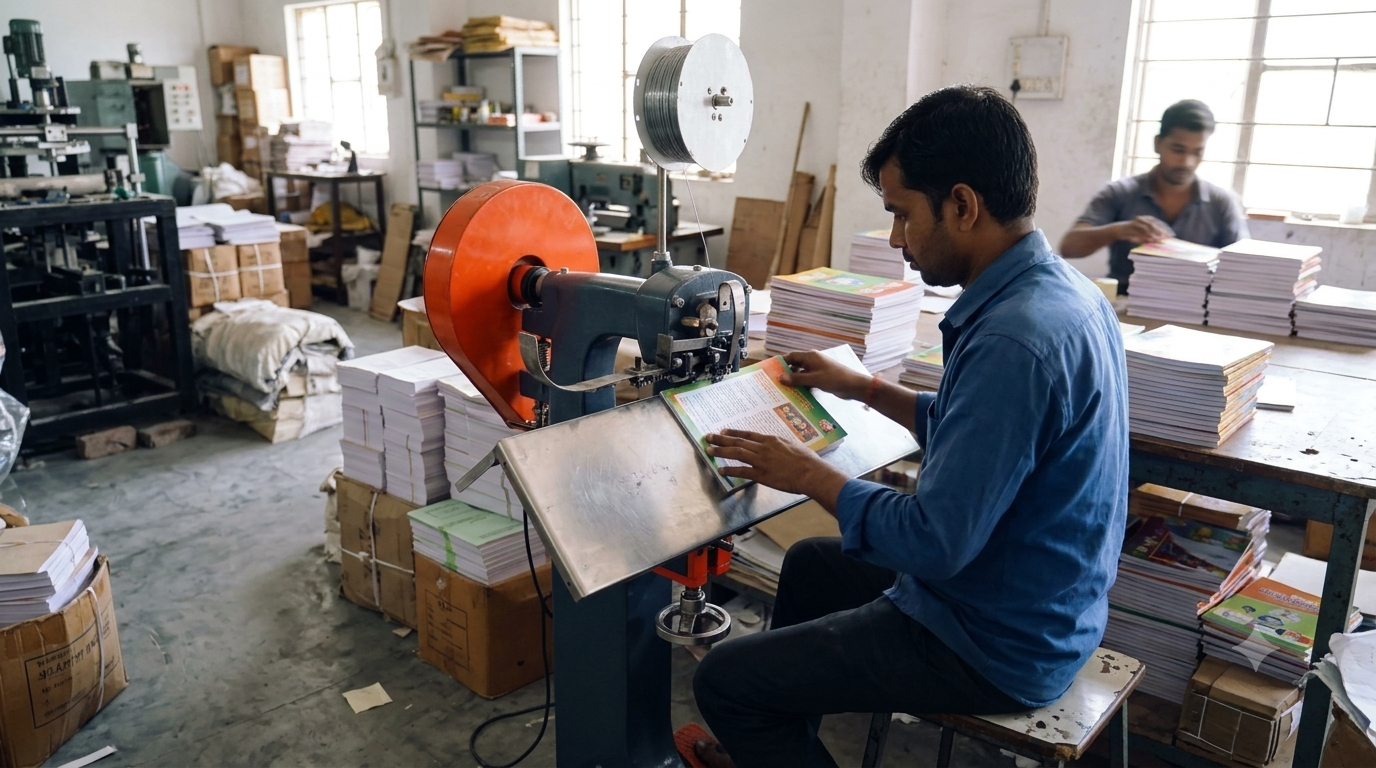
A notebook stitching machine is a machine used to stitch or pin the pages and cover of a notebook together.

It commonly uses metal stitching wire to secure the notebook at its binding edge. Depending on the notebook design and machine configuration, stitching may be performed at the centre or along a suitable binding edge.

The machine helps create a secure connection between the notebook's pages and cover.

Notebook stitching machines are used in the production of:

- School notebooks
- Exercise books
- Copies
- Small booklets
- Practice books
- Certain types of registers and stationery products

The machine is designed to make the stitching process more consistent and efficient than manual stapling.

WHY IS A NOTEBOOK STITCHING MACHINE IMPORTANT?

Notebook stitching is an important stage in notebook manufacturing because the pages must remain securely connected during regular use.

1. HOLDS NOTEBOOK PAGES TOGETHER

The main purpose of a notebook stitching machine is to join the pages and cover securely.

Proper stitching helps prevent pages from becoming loose or separating during normal handling.

2. IMPROVES PRODUCTION EFFICIENCY

In notebook manufacturing, many notebooks may need to be stitched in a single production run.

A stitching machine helps perform this operation repeatedly, reducing the time and effort required compared with manual stapling.

The actual production speed depends on the machine model, operator skill, notebook thickness, and production conditions.

3. PROVIDES CONSISTENT STITCHING

Correctly adjusted stitching helps maintain uniform placement and appearance across notebooks.

Consistent stitching is important for manufacturers supplying notebooks to stationery shops, wholesalers, schools, and distributors.

4. SUPPORTS NOTEBOOK MANUFACTURING BUSINESSES

A notebook stitching machine can be an important part of a small or medium-scale notebook manufacturing setup.

It allows manufacturers to perform the stitching process in-house rather than relying entirely on outside stitching services.

5. HELPS PRODUCE FINISHED STATIONERY PRODUCTS

Stitching connects the prepared paper sheets and cover into a notebook unit.

After stitching, the notebooks may undergo folding, pressing, edge squaring, trimming, quality checking, and packaging, depending on the manufacturing process.

HOW DOES A NOTEBOOK STITCHING MACHINE WORK?

The working process of a notebook stitching machine is straightforward.

The exact operating method varies by machine model, but a typical wire stitching process includes the following steps.

STEP 1: PREPARE THE NOTEBOOK SHEETS

The inner pages and cover are prepared according to the required notebook size and page count.

The pages may already be printed, ruled, cut, folded, and arranged before reaching the stitching stage.

STEP 2: ALIGN THE PAGES AND COVER

The notebook sheets and cover are placed together and aligned properly.

Correct alignment is important to ensure that the stitching is positioned accurately and the notebook looks neat.

STEP 3: POSITION THE NOTEBOOK ON THE MACHINE

The prepared notebook is placed on the machine's working table or stitching area.

The operator positions the notebook according to the required stitching location, such as centre stitching for suitable folded exercise books.

STEP 4: STITCHING WIRE IS APPLIED

The machine's stitching mechanism forms and drives the wire through the notebook material.

The wire is shaped to secure the pages and cover together.

STEP 5: COMPLETE THE STITCHING CYCLE

Once the stitching operation is completed, the notebook is removed from the machine.

The operator checks whether the stitching is properly formed and securely holds the pages.

STEP 6: INSPECT AND FINISH THE NOTEBOOK

The stitched notebook is checked for page alignment, stitching quality, and overall appearance.

Depending on the production setup, it may then be folded, pressed, trimmed, edge-squared, and packed.

WHY DOES A NOTEBOOK STITCHING MACHINE WORK?

A notebook stitching machine works through a mechanical wire-forming and fastening process.

The machine uses a stitching mechanism to cut, shape, and drive wire through the notebook pages and cover. The wire ends are formed to hold the notebook material together.

The stitching mechanism is designed to repeat this operation in a controlled manner.

The quality of stitching depends on several factors:

- Correct wire type and gauge
- Notebook thickness
- Proper machine adjustment
- Accurate page alignment
- Suitable stitching position
- Regular machine maintenance

When the machine is correctly adjusted and operated, it can produce secure and consistent stitching for notebook production.

TYPES OF NOTEBOOK STITCHING MACHINES

Notebook stitching machines are available in different configurations depending on production requirements.

1. MANUAL OR FOOT-OPERATED STITCHING MACHINE

This type of machine uses manual or foot-operated control to perform the stitching operation.

It may be suitable for smaller production requirements or businesses that prefer a simple operating system.

2. POWER-OPERATED NOTEBOOK STITCHING MACHINE

A power-operated notebook stitching machine uses a motor-driven mechanism to perform the stitching operation.

It can help improve production efficiency when compared with purely manual stitching methods.

3. CENTRE STITCHING MACHINE

Centre stitching is commonly used for suitable folded notebooks and exercise books.

The stitching is applied along the notebook's centre fold to secure the pages together.

The appropriate machine and wire configuration depend on the notebook thickness and design.

WHAT IS REQUIRED ALONG WITH A NOTEBOOK STITCHING MACHINE?

A notebook stitching machine performs the stitching operation, but a complete notebook manufacturing process may require other equipment as well.

Depending on the production setup, the following machines may be used:

- Paper cutting machine
- Paper ruling or printing machine
- Notebook folding machine
- Notebook stitching machine
- Edge squaring machine
- Notebook trimming machine
- Packaging equipment

Not every business needs all these machines from the beginning.

Some entrepreneurs purchase pre-ruled or pre-cut paper and use a smaller setup for gathering, stitching, finishing, and packaging. Others establish a larger production line with multiple machines.

The right setup depends on the required production capacity, product range, investment, and available workspace.

HOW TO START A NOTEBOOK MANUFACTURING BUSINESS

Starting a notebook manufacturing business requires planning the complete production and selling process.

1. STUDY THE LOCAL MARKET

Understand the demand for notebooks in your area.

Potential customers include:

- Stationery wholesalers
- Retail stationery shops
- Schools and colleges
- Coaching centres
- Office suppliers
- Notebook distributors

Research the notebook sizes, page counts, and designs preferred by your customers.

2. SELECT SUITABLE MACHINERY

Choose machinery according to your production requirements.

If stitching is your main requirement, a notebook stitching machine may be one of the important machines to consider.

Before purchasing, understand its stitching capacity, compatible wire, notebook thickness range, operating method, and maintenance requirements.

3. ARRANGE RAW MATERIALS

Notebook manufacturing generally requires:

- Writing paper
- Notebook covers
- Stitching wire
- Printing materials, where applicable
- Packaging materials

The quality of paper and cover material affects the finished notebook.

4. PREPARE YOUR WORKSPACE

Arrange sufficient space for the stitching machine, paper storage, finished notebooks, and packaging.

Ensure that the machine has the required electrical supply and that operators can work safely.

5. LEARN THE MACHINE'S OPERATION

Proper training helps operators understand how to position notebooks, adjust the stitching mechanism, select suitable wire, and inspect the finished product.

Training and regular maintenance can help reduce operating errors and improve consistency.

6. DEVELOP YOUR SALES NETWORK

Contact local stationery wholesalers, retailers, school suppliers, and distributors.

You can also explore customised notebook orders for schools, coaching centres, and businesses that require notebooks with their own branding.

IS A NOTEBOOK STITCHING MACHINE USEFUL FOR SMALL BUSINESSES?

A notebook stitching machine can be useful for small and medium-scale notebook manufacturers who want to perform the stitching process in-house.

It may help businesses:

- Reduce dependence on outside stitching services
- Maintain better control over stitching quality
- Process notebook orders more efficiently
- Support regular notebook production
- Expand their manufacturing activities gradually

However, the machine's suitability depends on the business's actual production requirements and budget.

Before investing, calculate machinery cost, paper cost, wire consumption, labour, electricity, packaging, transportation, and expected selling price.

CHOOSE A NOTEBOOK STITCHING MACHINE FROM BHARTIYA MACHINE WORKS

Bhartiya Machine Works (BWM), a brand by Vidayalaya Granth Pvt. Ltd., provides machinery solutions for entrepreneurs interested in manufacturing and stationery-related businesses.

If you are planning to start or expand a notebook manufacturing unit, choosing suitable machinery and understanding the production process are important steps.

A notebook stitching machine can help you perform the notebook binding stage efficiently and maintain consistent stitching in your finished products.

At Bhartiya Machine Works, you can explore notebook manufacturing machinery and learn more about the equipment required for your business.

CONCLUSION

A notebook stitching machine is an important machine in the notebook manufacturing process.

It joins notebook pages and covers through a wire stitching mechanism, helping produce notebooks that are securely bound and ready for finishing.

For entrepreneurs interested in notebook manufacturing, understanding the stitching process, selecting suitable machinery, maintaining quality, and developing a reliable customer network are important steps toward building a business.

The right machine should be selected according to your production requirements, notebook design, and business plan.

Bhartiya Machine Works – Helping Entrepreneurs Explore Manufacturing Opportunities.